Home / States / Debt collection laws by state
How well does your state protect you from debt collectors?
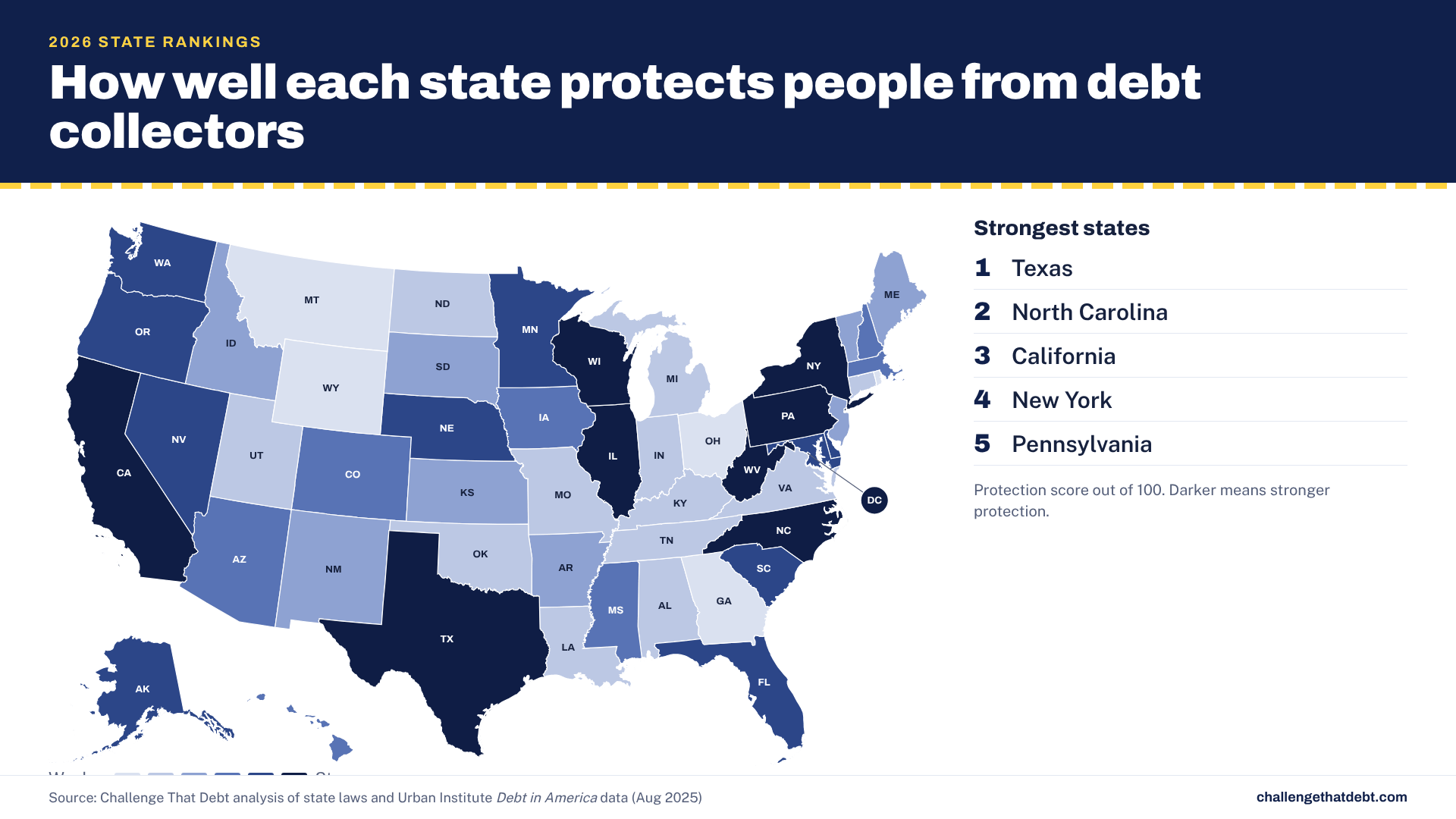
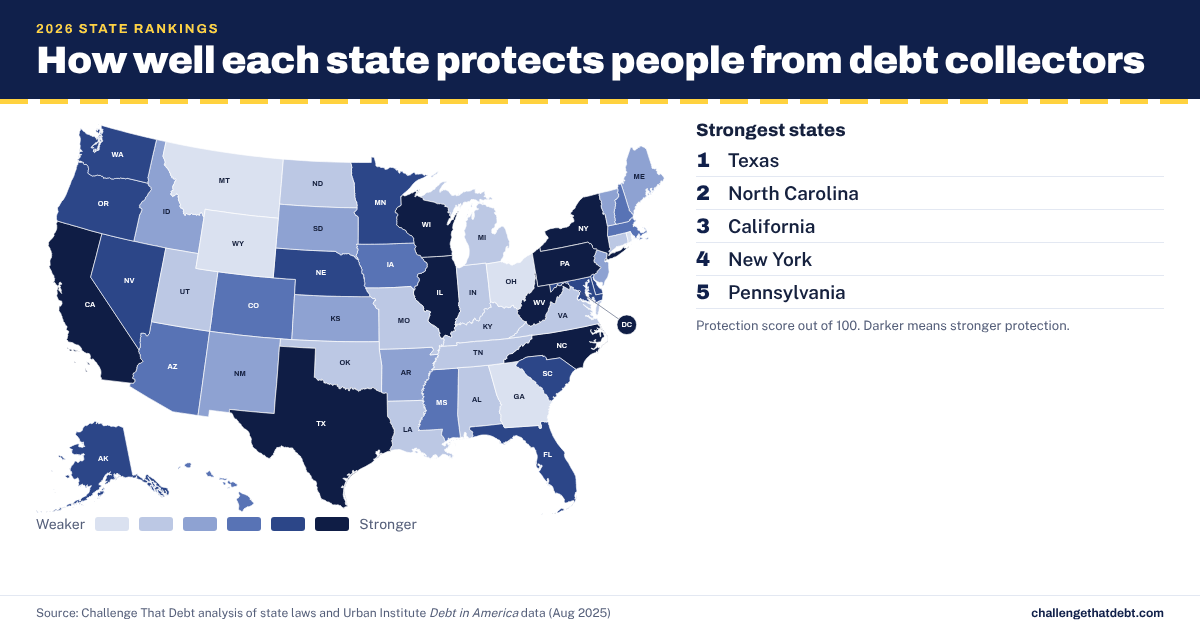
We scored every state and DC on the rules that matter most when a collector comes calling: how long it can sue, how much of your pay it can take, whether a payment restarts the clock, and whether collectors need a license. Pick a state to see its score and the law behind it.
How long a collector can sue you
Every state, ranked
Select a column heading to sort. Select a state to see it on the map.
For press
Reporters and publishers are free to use these graphics with credit to Challenge That Debt and a link to this page. Every state also has its own graphic: pick a state on the map and use the download link in its panel. For interviews or the full dataset, email [email protected].
How we score states
The protection score is out of 100. It weighs four rules taken from our state guides and, where a guide doesn't yet cover a rule, from the state statute or regulator page we cite on the map for that state:
- Paycheck protection (35%). 100 if wages can't be garnished for consumer debt, 70 for a lower cap than federal law, 50 for special protections such as head-of-family or yearly caps, and 0 for the federal limit of up to 25%. See our wage garnishment guide.
- Time limit to sue (35%). Shorter is better: 3 years scores 100 and 10 years scores 0, on a straight line. See the table of time limits with sources.
- Whether a payment restarts the clock (15%). 100 if it doesn't, 75 if only a signed written promise does, 0 if a payment can.
- Collector licensing (15%). 100 if collection agencies must be licensed or registered, 50 for partial rules, 0 if not.
Where our guide doesn't yet state a rule, that part is left out and the other parts are reweighted, so no state is marked down for a gap in our coverage.
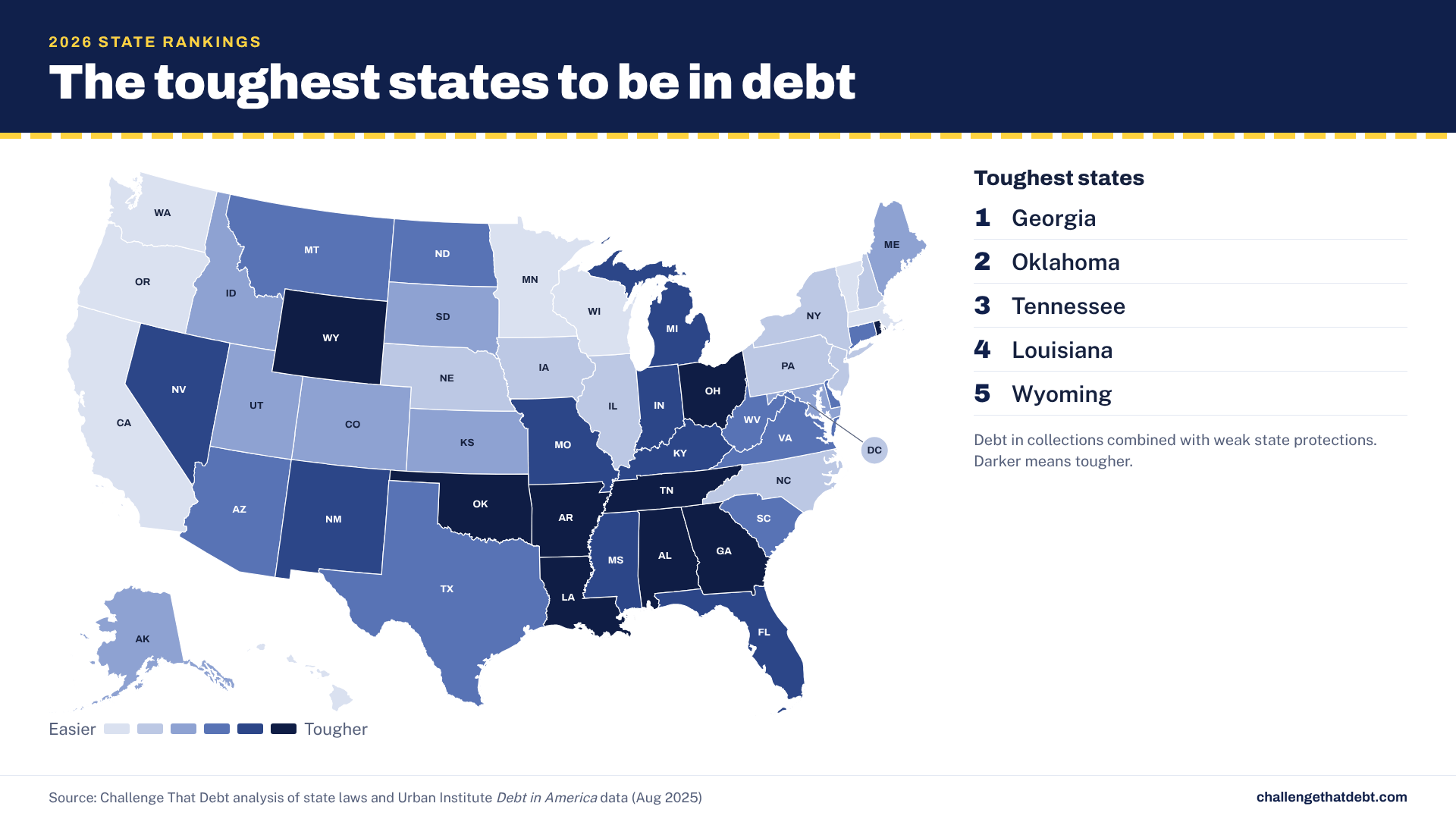
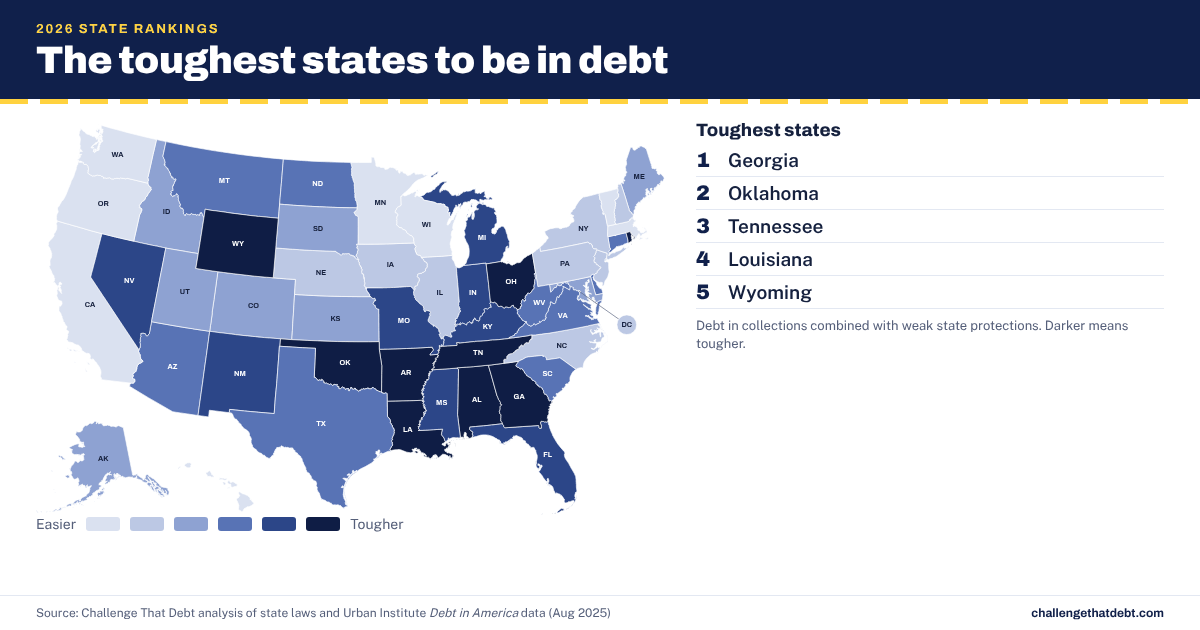
The toughest-to-be-in-debt ranking adds how much debt people carry to how weak their state's protections are. The debt side uses four measures from the Urban Institute's Debt in America data (credit records from August 2025): the share of people with any debt in collections (40%), the typical amount in collections (20%), the share with medical debt in collections (20%), and the share of credit card debt 60 or more days late (20%). Each measure is turned into a percentile, so a state at the top of a measure scores 100 on it. The final ranking is the average of that debt score and the reverse of the protection score.
In seven states (California, Colorado, Illinois, New York, Rhode Island, Vermont and Washington) no medical debt in collections appears on credit records, so that measure is left out for them rather than counted as zero.
Debt data: Breno Braga, Signe-Mary McKernan, Samantha Atherton and Kassandra Martinchek, Debt in America, Urban Institute, last updated November 20, 2025, used under the Open Data Commons Attribution License.
Scores simplify complicated laws, and some debts and contracts follow different rules. Found something out of date? Email [email protected] and we'll check it. This page is general information, not legal advice.